Whispers of Stone and Sky: A Hidden Art Journey Through the Dolomites
Have you ever stood somewhere so breathtaking it felt like a painting come to life? The Italian Dolomites aren’t just peaks and trails—they’re a living canvas. Far beyond the postcard views, I discovered quiet villages where centuries-old frescoes still watch over mountain squares, and alpine chapels hide sculptures shaped by wind and prayer. This is art not in galleries, but in the silence between cliffs, in stone carvings kissed by alpine light. My journey wasn’t about ticking off sights—it was about feeling culture rise from the rock itself. In every carved lintel, every weathered fresco, there was a story whispered across generations, waiting to be heard by those who walk with quiet hearts.
The Art-Laden Landscape: Where Nature and Culture Merge
The Dolomites rise like a geological symphony—towering spires of pale limestone, sheer cliffs that glow rose-gold at dawn, and valleys carved by ancient glaciers. Yet beyond their visual grandeur lies a deeper harmony: the seamless fusion of nature and human artistry. For centuries, the people of this region have not merely lived in the mountains—they have conversed with them. Their response has been an enduring tradition of artistic expression shaped by altitude, isolation, and reverence. This is not a landscape where art was imported; it grew organically from the rock, the timber, and the soul of the community.
Woodcarving, in particular, has long been a cornerstone of alpine craftsmanship. In family homes and mountain huts, intricately carved cupboards, doors, and religious figures bear witness to a culture that values both utility and beauty. The linden tree, abundant in these valleys, provides soft, workable wood ideal for delicate sculpture. Generations of artisans have used it to shape saints with serene faces, animals caught mid-motion, and mythical beings drawn from local lore. These pieces are not merely decorative—they are devotional, protective, and deeply rooted in daily life. A carved Madonna above a doorway is not just art; it is a guardian.
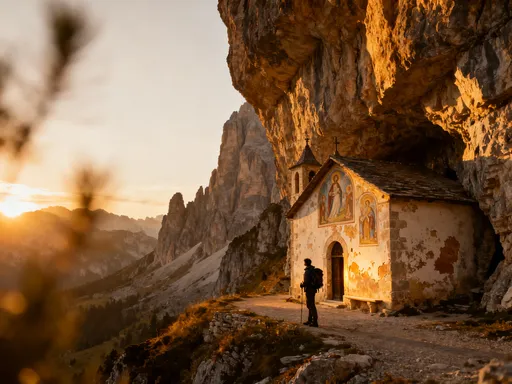
Sacred art is equally embedded in the landscape. Small chapels dot hiking trails, perched on ridgelines or nestled in meadows, each containing hand-carved crucifixes, painted altarpieces, or votive offerings left by travelers and shepherds. These are not museum pieces behind glass—they are part of a living tradition, touched by weather and prayer alike. The art of the Dolomites does not ask to be admired from a distance; it invites participation, contemplation, and quiet respect. This integration of culture into the natural world creates an atmosphere unlike any other in Italy—a place where the sacred and the scenic are inseparable.
The Dolomites’ UNESCO World Heritage status recognizes not only their geological significance but also their cultural value. The interplay between terrain and tradition has fostered a unique regional identity, particularly among the Ladin people, whose language and customs have survived for over a thousand years. Their art reflects a worldview shaped by resilience and harmony—with nature, with faith, and with time. To walk through these valleys is to move through an open-air museum where every village square, every church wall, and every mountain pass holds a fragment of a larger story.
San Candido and the Hidden Frescoes of St. Michael’s Church
Nestled in the upper Puster Valley, near the border with Austria, the town of San Candido (known as Innichen in German) exudes a tranquil charm. Cobblestone streets wind past pastel-colored buildings with flower-filled balconies, and the distant silhouette of the Three Peaks of Lavaredo looms on the horizon. But within this picturesque town lies one of the Dolomites’ most profound artistic treasures: the Church of San Michele Arcangelo, home to remarkably preserved 12th-century frescoes that speak across centuries with quiet power.
Step inside, and the world outside fades. The interior is modest in size but rich in spiritual resonance. On the walls and arches, scenes from the life of Christ unfold in earthy reds, ochres, and faded greens. The frescoes, executed in the Romanesque style, are characterized by bold outlines, expressive figures, and symbolic rather than realistic representation. One panel depicts the Last Judgment, with Christ enthroned at the center, angels blowing trumpets, and souls being weighed—a reminder of mortality and divine justice. Another shows the Nativity, with the Virgin Mary reclining beneath a starry canopy, her face serene, the infant Jesus glowing with a golden halo.
What makes these frescoes extraordinary is not only their age but their survival. Hidden beneath layers of whitewash for centuries, they were rediscovered during restoration work in the 19th century. Their preservation is a testament to the care of local custodians and the dry, stable climate of the alpine church. Unlike some restored artworks that feel sanitized, these frescoes retain their authenticity—the cracks in the plaster, the uneven pigments, the traces of candle smoke—all adding to their emotional depth.
Visitors are welcome to view the frescoes, though with a request for reverence. The church remains an active place of worship, and moments of silence are observed during services. Opening hours are generally from 8:00 a.m. to 6:00 p.m., though it’s advisable to check locally, especially in winter. There is no admission fee, but donations support ongoing conservation. Photography is permitted without flash, allowing travelers to capture the beauty without disturbing the sacred atmosphere. For those seeking a deeper understanding, guided tours are occasionally offered by the local cultural office, providing historical context and insight into the symbolism of the scenes.
To stand before these frescoes is to feel the weight of time and the continuity of faith. They were painted for a community that lived close to the land, dependent on the seasons and the protection of saints. Today, they offer modern travelers a rare opportunity to connect with a spiritual and artistic heritage that has endured through war, change, and modernity. In their quiet dignity, they remind us that art can be both eternal and intimate.
Ortisei: The Heartbeat of Ladin Sculpture and Craft
If San Candido holds the soul of the Dolomites’ sacred art, Ortisei (known as St. Ulrich in German) is its artistic pulse. Located in the Val Gardena, this village is renowned as the heart of Ladin woodcarving, a tradition that dates back to the 17th century. As you walk its cobbled streets, the air carries the faint scent of sawdust and linseed oil. Shop windows display delicate nativity figures, intricately carved crucifixes, and lifelike animal sculptures—each piece bearing the mark of generations of skilled hands.
The craft of woodcarving in Ortisei began as a necessity. In the long, isolated winters, farmers and shepherds turned to carving as a way to supplement their income. Over time, it evolved into a refined art form, passed down through family workshops. Today, many of these ateliers remain family-run, with grandfathers teaching sons and daughters the precise cuts, the subtle curves, the patience required to bring wood to life. The tradition is not frozen in time; contemporary artists experiment with form and expression while honoring the techniques of the past.
One of the best places to experience this living tradition is the Museum Gherdëina, a modern, light-filled space that houses over 600 carved works, from 17th-century religious figures to avant-garde sculptures. The museum does not treat woodcarving as a relic but as a dynamic cultural force. Temporary exhibitions showcase new interpretations, and educational programs invite visitors to try their hand at carving under the guidance of local artisans. It’s a rare example of a community museum that is both scholarly and deeply connected to daily life.
Each year in summer, Ortisei transforms into an open-air gallery during the Ortisei Sculpture Festival. Local and international artists install large-scale works in the village square, along the riverbank, and in the surrounding forests. Bronze, stone, and wood pieces engage in dialogue with the landscape, creating a dynamic interplay between nature and human creativity. Unlike commercial art fairs, this event emphasizes dialogue, sustainability, and accessibility. Families gather to discuss the pieces, children sketch in notebooks, and artists are often present to speak about their work.
What sets Ortisei apart is the absence of kitsch. While souvenirs are available, the focus remains on craftsmanship and authenticity. A simple wooden angel purchased from a local workshop is not mass-produced; it is signed, dated, and often blessed in a small chapel before being sold. This reverence for the object, for the process, and for the spiritual dimension of art elevates the entire tradition. For the traveler, Ortisei offers more than shopping—it offers a window into a culture where art is not separate from life but woven into its very fabric.
Alpine Chapels as Open-Air Galleries: Art in Sacred Solitude
Scattered across the high meadows and rocky passes of the Dolomites are small chapels—humble structures with stone walls, wooden doors, and iron crosses atop their roofs. These are not grand cathedrals but quiet sanctuaries, often visited only by hikers, shepherds, or the occasional pilgrim. Yet within their modest interiors lies some of the most moving art in the region: hand-carved crucifixes with faces etched in sorrow, votive paintings left as thanks for safe passage, and altars adorned with wildflowers picked that morning.
Take, for example, the Chiesetta di San Giovanni, a tiny chapel near the Seceda ridge. From the outside, it appears almost invisible—just a low stone building blending into the landscape. Step inside, and the air is cool, still. On the altar rests a 19th-century wooden Christ figure, his body twisted in agony, his eyes closed in surrender. The craftsmanship is rough, unpolished, yet profoundly expressive. This is not art designed for beauty alone; it is art born of devotion, shaped by hands that knew hardship and sought solace.
Many of these chapels contain ex-voto paintings—small panels donated by individuals who survived avalanches, accidents, or illness. Painted in simple, folk-art style, they depict dramatic scenes: a man falling from a cliff, a house engulfed in flames, a storm at sea—each followed by a small figure kneeling in prayer, with a banner reading “Grazie” (Thank you). These are not just artworks; they are testimonies. They speak of fear, gratitude, and the human need to make meaning of suffering.
The chapels themselves are acts of artistry. Built without modern machinery, they reflect a deep understanding of alpine architecture—thick walls to retain heat, steep roofs to shed snow, foundations anchored into bedrock. Their placement is deliberate: facing east to greet the sunrise, or positioned at crossroads where paths converge. Some are adorned with engraved stone markers or carved wooden eaves, each detail carrying symbolic meaning. A sunburst carving might represent divine light; a dove, the Holy Spirit.
For the traveler, visiting these chapels is not about ticking off a list but about pausing. They offer moments of stillness, reflection, and unexpected beauty. There are no entrance fees, no crowds, no guided tours—just the choice to enter quietly, to look closely, and to listen. In a world that often equates value with visibility, these chapels remind us that some of the most powerful art exists in solitude, sustained by faith and silence.
The Ladin Language and Storytelling as Cultural Artistry
Art in the Dolomites is not only seen—it is heard. The Ladin people, an ethnic minority with roots tracing back to the Roman Empire, have preserved a Romance language that survives in isolated valleys of South Tyrol. Spoken by fewer than 30,000 people, Ladin is a living thread connecting the present to a distant past. But beyond language, it is the tradition of storytelling—oral histories, folk tales, and sung ballads—that forms an essential, intangible art form.
During village festivals, especially in autumn and winter, elders gather in community halls to share stories passed down through generations. These are not mere entertainments; they are cultural transmissions. Tales of mountain spirits, brave shepherds, and miraculous interventions blend history with myth, teaching values of courage, humility, and respect for nature. The rhythm of the language, with its soft consonants and melodic cadence, adds a lyrical quality, turning speech into song.
One well-known Ladin legend tells of the “Fanes,” a lost kingdom hidden in the mountains, ruled by a queen who could transform into a chamois. The story speaks of harmony with nature, the consequences of greed, and the fragility of beauty—themes that resonate deeply in a landscape so easily disrupted. When told around a fire or sung during a procession, the tale becomes more than narrative; it becomes ritual, a way of anchoring identity in place and memory.
Travelers can experience this tradition during cultural evenings hosted in villages like Santa Cristina or Selva di Val Gardena. These events are not staged for tourists but are genuine community gatherings. Visitors are welcome to attend, often with translations provided. Some local schools also offer storytelling workshops, where children learn to recite traditional tales in Ladin, ensuring the language continues to thrive.
The survival of Ladin is due in part to strong cultural advocacy. Bilingual signage, Ladin-language media, and inclusion in school curricula have helped sustain the language. But it is the everyday use—in homes, in churches, in local songs—that keeps it alive. For the traveler, listening to a Ladin story is not just an encounter with folklore; it is an invitation to witness a culture that values continuity, memory, and the quiet power of words.
Walking the Alta Via 1 with an Artist’s Eye: Trail as Gallery
The Alta Via 1 is one of the most celebrated long-distance hikes in the Dolomites, stretching approximately 120 kilometers from Lago di Braies to Belluno. Traditionally described as a trek for adventurers, it can also be reimagined as a curated journey through a natural and cultural gallery. With an artist’s eye, each stage reveals not just geological wonders but human imprints—old shepherd huts, engraved boundary stones, wayside shrines—that transform the trail into a living exhibition.
One of the most iconic sections is the approach to Lago di Sorapis, a turquoise alpine lake nestled beneath sheer cliffs. The path winds through forests and scree slopes, but attentive hikers will notice subtle artistic details: a small wooden cross nailed to a tree, a stone cairn arranged with care, a faded painting of the Virgin Mary tucked into a rock crevice. These are not random; they are markers of passage, devotion, and remembrance.
Near the Seceda ridgeline, the trail passes an old malga—a summer pasture hut—now converted into a cultural shelter. Inside, rotating exhibits display photographs of traditional alpine life, carved wooden tools, and maps of ancient grazing routes. Run by local volunteers, the space serves as both museum and rest stop, offering tea and conversation. It’s a rare example of how heritage can be integrated into the hiking experience without commercialization.
Another highlight is the Puez-Odle Nature Park, where weathered boundary stones bear intricate carvings—initials, dates, religious symbols—left by shepherds and land surveyors over centuries. These stones, often overlooked, are quiet artworks, their engravings softened by wind and rain. They speak of ownership, memory, and the human need to mark space.
For those planning the trek, integrating art stops requires only slight adjustments. Staying an extra night in Ortisei allows time for the museum and ateliers. Choosing rifugi (mountain huts) managed by local cooperatives supports community-run initiatives. Carrying a guidebook on Dolomite art or downloading a cultural trail map can deepen the experience. The goal is not to rush from summit to summit, but to walk slowly, observe closely, and let the landscape reveal its stories.
Traveling with Reverence: How to Experience Dolomite Art Sustainably
The beauty of the Dolomites is fragile. Foot traffic, climate change, and commercial development threaten both the natural environment and the cultural heritage it sustains. To truly honor the art of this region, travelers must adopt a mindset of reverence and responsibility. Sustainable tourism is not just about reducing waste or choosing eco-friendly accommodations—it is about respecting the living culture embedded in the landscape.
One of the most impactful choices is timing. Visiting in the shoulder seasons—late spring or early autumn—reduces pressure on trails and villages. Summer months bring large crowds, especially to popular sites like Lago di Braies or Seceda, where congestion can damage vegetation and disturb the peace of sacred spaces. In contrast, a September visit offers mild weather, fewer people, and the chance to experience local harvest festivals and storytelling events.
Supporting local artisans directly is another vital practice. Instead of buying mass-produced souvenirs, seek out family workshops in Ortisei, Castelrotto, or San Candido. Purchase a hand-carved figure, a woolen scarf from a Ladin weaver, or a jar of mountain honey from a local farm. These small acts sustain traditional economies and ensure that cultural practices continue.
When visiting churches and chapels, observe basic etiquette: dress modestly, speak softly, avoid flash photography, and never touch artworks unless permitted. Many sacred spaces rely on voluntary donations; contributing even a small amount helps with maintenance. If guided tours are available, choose those led by local cultural stewards—often historians, artists, or longtime residents—who offer authentic insight rather than rehearsed narratives.
Finally, practice mindfulness. Put away the phone. Sit quietly in a chapel. Listen to the wind in the pines. Notice the way light falls on a fresco at midday. True appreciation of Dolomite art comes not from accumulation but from presence. It is in these quiet moments that the whispers of stone and sky become audible.
When Mountains Speak in Color and Stone
The Dolomites offer more than scenic vistas—they offer a dialogue. Between cliff and carving, between trail and tale, there is a conversation spanning centuries. This is not a destination to be conquered or collected, but a culture to be entered with humility and openness. The art here does not hang on walls; it grows from the ground, shaped by hands that know the weight of a chisel and the silence of prayer.
To travel through the Dolomites with an artist’s eye is to see beyond the obvious. It is to notice the curve of a wooden saint’s hand, the faded red of a fresco’s robe, the Ladin word sung softly in a village square. These are not remnants of the past but living expressions of identity, resilience, and beauty. They remind us that culture is not separate from nature—it is its echo, its response, its soul.
As you plan your journey, ask not only where you will go, but how you will see. Will you rush to the summit, or pause at the chapel? Will you buy a souvenir, or carry a story home? The mountains have much to say, if we learn to listen. In the end, the true masterpiece is not a painting or a sculpture, but the moment when a traveler stands still, heart open, and hears the whisper of stone and sky.