Hidden Athens: The Viewpoints Only Locals Know
Athens isn’t just about the Acropolis and crowded tourist trails. Beyond the postcard spots, the city reveals quiet rooftops, secret stairways, and hillside paths where the sky meets ancient stone in perfect silence. I’ve wandered its neighborhoods for years, chasing golden light and unfiltered moments. These hidden viewpoints offer more than scenery—they give you Athens’ soul. Trust me, seeing this city from above changes everything. It’s not just the panorama that moves you, but the sense of discovery, of standing where few travelers dare to look. This is Athens as it’s lived, not sold. And once you’ve seen it this way, you’ll never view the city the same again.
Why Athens Deserves a Deeper Look
Athens is often experienced in snapshots: the Parthenon rising at dawn, the bustling streets of Monastiraki, the marble steps of ancient theaters. These sights are undeniably powerful, but they represent only one layer of a deeply textured city. For many visitors, the experience ends where the guidebooks stop. Yet the true essence of Athens unfolds slowly, in quiet moments far from the curated paths. To understand this city, you must look beyond the monuments and begin to see the spaces between them—the courtyards, the alleyways, the unmarked trails that lead to breathtaking views known only to those who live here.
What sets Athens apart is not just its history, but the way that history lives in dialogue with the present. Ancient ruins are not isolated relics but part of the city’s daily rhythm. A 2,500-year-old wall might form the boundary of a modern garden. A Byzantine church stands quietly beside a bustling café. This coexistence creates a unique emotional landscape—one where awe and intimacy exist side by side. By seeking out lesser-known vantage points, travelers gain more than a better photograph; they gain context. They see how the city breathes, how light shifts across marble in the late afternoon, how life unfolds in the shadow of eternity.
Finding these hidden perspectives requires a shift in mindset. Instead of checking off landmarks, the goal becomes presence—being still, observing, and allowing the city to reveal itself. This kind of travel is not about speed or efficiency. It’s about depth. It’s about sitting on a quiet bench as the call to prayer from a historic mosque blends with the chime of church bells, or watching a cat stretch across sun-warmed stone as the Acropolis glows in the distance. These moments, fleeting and unscripted, are what make a journey memorable. And they are available to anyone willing to look a little closer, climb a little higher, and listen a little more.
The Acropolis View Most Tourists Miss
Just below the southern slope of the Acropolis, where the noise of the main entrance fades into a distant hum, there’s a small, unassuming bench tucked between olive trees and fragments of ancient wall. Few tourists notice it, and even fewer make the short detour to sit. But those who do are rewarded with one of the most intimate views of the Parthenon in the city. Unlike the crowded terrace at the main site, this spot offers a full frontal perspective without the crowds, the selfie sticks, or the constant movement of tour groups. Here, the temple stands in quiet dignity, framed by gnarled branches and the soft rustle of leaves.
To find it, walk along the Dionysiou Areopagitou pedestrian path, just past the entrance to the Acropolis Museum. Look for a narrow dirt trail branching off to the left, marked only by a small stone step and a weathered sign pointing toward the Theatre of Dionysus. Follow the path as it curves gently uphill, passing patches of wild thyme and clusters of pink rock roses. After a few minutes, you’ll see the bench—a simple wooden slat resting on stone blocks—positioned perfectly to face the Parthenon. There’s no railing, no signage, no ticket required. Just stillness and an unobstructed view.
The best time to visit is late afternoon, when the sun begins its descent and bathes the limestone columns in a warm, golden light. Shadows stretch across the temple’s pediments, revealing details often lost in the midday glare. If you stay past sunset, the experience deepens. As the city lights begin to flicker on, the Acropolis is softly illuminated, standing like a beacon above the darkening streets. The contrast between the ancient structure and the modern metropolis below is striking—a reminder that Athens is not a museum, but a living, evolving city. This is the view that locals cherish, the one they return to when they need to remember why they love this place.
Philopappos Hill: More Than Just a Park
Philopappos Hill is a favorite among Athenians for morning walks, afternoon picnics, and evening strolls. Known for its shaded paths, resident turtles, and panoramic views, it’s often seen as a peaceful escape from the city’s intensity. But beyond the main trails lies a network of lesser-known paths, some overgrown and unmarked, that lead to secluded vantage points with unmatched views of the Acropolis. One such spot—a flat limestone ledge hidden behind a cluster of pine trees—offers a near-perfect alignment of the Parthenon framed by the natural curve of the hill.
To reach it, start from the Dipylon Gate entrance near the Pnyx and follow the central path uphill. Instead of turning toward the Philopappos Monument, continue straight along a narrow trail that becomes less defined as it climbs. After about ten minutes, you’ll come to a fork; take the left path, which descends slightly before opening onto a small clearing. From there, a short scramble over smooth rock leads to the ledge. It’s not marked on any official map, and there’s no railing, so caution is advised. But for those who make the effort, the reward is solitude and a view that feels almost private.
Local families often bring blankets and fruit to this spot, using it as a quiet place to relax away from the noise of the city. Teenagers whisper secrets on weekend evenings. Elderly couples sit in companionable silence, watching the light change over the temple. The atmosphere is one of gentle reverence, not tourism. There’s a sense that this place is shared, not claimed. Visitors who come here are expected to respect that unspoken rule: to speak softly, leave no trace, and appreciate the moment without disrupting it. The combination of natural beauty and historical grandeur creates a rare kind of peace—one that stays with you long after you’ve returned to the streets below.
Roof Bars That Feel Like Secret Terraces
Not every unforgettable view requires a hike. Some of the most magical panoramas in Athens come from rooftop bars tucked into the upper floors of old apartment buildings in neighborhoods like Psiri and Koukaki. While places like 360 Athens attract crowds with their reputation, smaller, lesser-known spots offer a more intimate experience. These are not luxury lounges with bottle service, but family-run cafés and neighborhood bars where the focus is on connection, not spectacle. The drinks are simple—local retsina, cold beer, or a glass of Assyrtiko wine—and the music, if any, is low and unobtrusive.
One such place is a small café on the top floor of a five-story building in Psiri, accessible only by a narrow staircase and an unmarked door. From its wooden balcony, the view stretches across a sea of red rooftops to the Acropolis, which glows in the evening light like a distant lantern. There are no reservations, no dress code, and no minimum spend. Just a handful of tables, a few potted herbs, and a view that feels like a secret. The owners, a married couple in their fifties, greet regulars by name and offer homemade snacks to first-time guests. It’s the kind of place where time slows down, where you might strike up a conversation with a local artist or a retired teacher sharing stories of the city’s past.
Another hidden gem is a quiet bar in Koukaki, perched above a quiet street lined with fig trees. Its rooftop terrace is so well concealed that even many Athenians don’t know it exists. The entrance is easy to miss—a plain metal door between a bakery and a dry cleaner—but once upstairs, the city unfolds in every direction. On clear nights, you can see the lights of Piraeus across the Saronic Gulf. The air carries the scent of grilled octopus from a nearby taverna and the faint sound of bouzouki music drifting from an open window. These spaces are not designed for Instagram; they’re designed for presence. They remind us that the best moments of travel often happen not in grand settings, but in quiet corners where authenticity still thrives.
The Stairway to Anafiotika’s Skyline
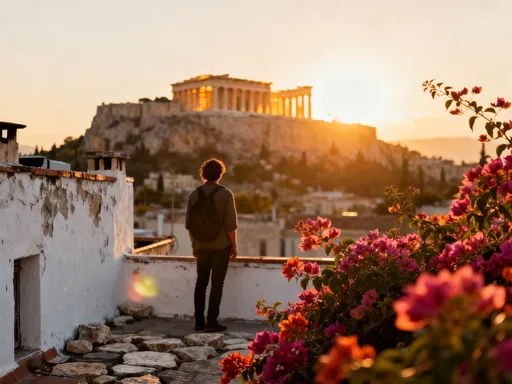
Behind the grandeur of Syntagma Square, where the Presidential Guard performs its ceremonial changing of the guard, a narrow stone staircase winds upward into one of Athens’ most enchanting neighborhoods—Anafiotika. Built in the 19th century by workers from the Cycladic island of Anafi, this village-like enclave clings to the northern slope of the Acropolis. Its whitewashed houses, blue doors, and winding paths feel more like a Greek island than a capital city. And halfway up the staircase, just before the path splits into a maze of alleys, there’s a small landing that offers one of the most picturesque views in Athens.
Framed by bougainvillea-draped arches and centuries-old stone walls, the view from this landing captures the essence of the city in a single glance. Rooftops cascade downward like waves, their terracotta tiles glowing in the sunlight. Church domes rise like sentinels, their crosses catching the light. And in the background, the Acropolis stands in quiet majesty, its columns glowing against the blue sky. It’s a scene that feels both timeless and immediate, as if the past and present are momentarily in perfect balance.
The sensory experience is just as powerful as the visual one. The air is thick with the scent of jasmine and wild oregano. The sound of a distant fountain mingles with the soft chime of wind bells. A cat darts across a courtyard, disappearing behind a wall covered in climbing ivy. This is not a view you find on postcards, but it’s one you’ll remember long after your trip ends. The climb takes less than five minutes, yet it transports you from the formality of the city center to a place of quiet charm and unexpected beauty. It’s a reminder that sometimes, the most profound experiences come from the simplest detours.
Lycabettus at Night: Skip the Sunset Hype
Lycabettus Hill is famous for its sunset views, drawing crowds who flock to the summit via the funicular or on foot to watch the sky turn gold and pink. But while the sunset is undeniably beautiful, the real magic begins after dark. Once the last tourists have descended and the funicular shuts down, the summit becomes still. The city lights stretch out in every direction, creating a sea of shimmering points that resemble stars reflected on water. The Acropolis, now softly illuminated, stands as a glowing centerpiece in the distance. The air is cooler, quieter, and filled with a sense of calm that’s hard to find elsewhere in the city.
To experience this, it’s best to arrive just before midnight, either by walking up the path from Kolonaki or taking a taxi to the base and starting the climb from there. The trail is well-marked and safe, with occasional lighting and clear signage. As you ascend, the sounds of the city fade, replaced by the rustle of dry grass and the occasional call of a night bird. When you reach the top, you’ll likely find only a handful of people—locals enjoying a quiet moment, couples sitting on benches, or solitary travelers gazing at the horizon.
Bring a thermos of Greek coffee or a small snack, and find a spot away from the chapel and the viewing platforms. Sit on the rocks, wrap yourself in a light jacket, and simply be. The contrast between the daytime energy and the nighttime stillness is profound. By day, Lycabettus is a destination. By night, it’s a sanctuary. This is the Athens that doesn’t show itself to everyone—the one that reveals its depth only to those who are willing to stay a little longer, to climb a little later, and to listen in the dark.
How to Find Your Own Hidden View
The best viewpoints in Athens are not always the ones listed in guidebooks. Many of the most beautiful spots are discovered by accident—by following a stray cat down an alley, by noticing an open gate in an old building, or by asking a café owner where they go to watch the sunset. The key to finding these places is curiosity, patience, and a willingness to wander without a fixed destination. It’s about paying attention to small details: a staircase that seems to go nowhere, a rooftop door left ajar, a patch of green visible above a wall.
Locals are often the best source of information. A simple question—“Where do you go to see the city?”—can lead to unexpected invitations. Many Athenians are proud of their city and happy to share its quieter corners with respectful visitors. But it’s important to approach these spaces with care. These viewpoints are not attractions; they are part of people’s daily lives. Trespassing, littering, or using drones without permission disrupts that balance. The goal is not to claim a view, but to appreciate it.
A good pair of walking shoes is essential. Athens is a city best explored on foot, and many of its hidden gems are accessible only by narrow staircases, uneven paths, or steep inclines. But the effort is always worth it. Each climb, each turn, each unexpected opening offers the possibility of discovery. And when you finally find that quiet spot—where the city spreads out below and the sky stretches endlessly above—you’ll understand why these moments matter. They’re not just about seeing Athens from a new angle. They’re about feeling connected to it, about becoming part of its rhythm, even if only for a little while.
Conclusion: Seeing Athens Differently
Athens reveals itself slowly. The monuments are breathtaking, but the city’s true beauty lives in its quiet corners and unexpected heights. These hidden viewpoints offer more than photos—they offer presence. They invite you to step away from the crowds, to slow down, and to see the city not as a checklist of sights, but as a living, breathing entity. In these moments of stillness, you begin to understand Athens not just with your eyes, but with your heart.
The Acropolis will always be the symbol of the city, and rightly so. But the soul of Athens is found in the spaces around it—in the rooftop where an old man sips his coffee at dawn, in the hidden ledge where a couple shares a quiet conversation, in the stairway where a child laughs as she chases a butterfly. These are the moments that define a journey. They are not staged, not filtered, not rushed. They are real.
By seeking out these lesser-known perspectives, you do more than expand your itinerary. You deepen your experience. You move from observer to participant. And in doing so, you don’t just see Athens more clearly—you begin to feel it. In the end, the best travel memories aren’t taken. They’re found. And in a city like Athens, they’re waiting just beyond the next turn, just above the next hill, just out of sight—but never out of reach.