This Place Looks Unreal—Wait Until You See Fiordland’s Hidden Faces
You know that feeling when nature just slaps you in the face with beauty? That’s Fiordland. Nestled near Te Anau, this wild corner of New Zealand isn’t just scenic—it’s surreal. Sheer cliffs rise from dark waters, waterfalls explode down rock faces, and the air feels ancient. As a traveler obsessed with raw landscapes, I didn’t expect to be speechless. But here’s the truth: Te Anau’s terrain isn’t made for photos. It’s made for awe. In a world where so many destinations feel curated or predictable, Fiordland remains defiantly unscripted. It doesn’t perform—it simply exists, on its own majestic terms. To visit is not to conquer, but to witness something older than memory, shaped by ice and time.
Arrival in Te Anau: Gateway to the Extraordinary
Te Anau is not a city. It’s not even a town in the bustling sense. With fewer than 2,500 permanent residents, it exists as a quiet punctuation mark along the edge of Lake Te Anau, the largest freshwater lake in New Zealand by volume. Yet, its modest size belies its significance. This is the official gateway to Fiordland National Park, a UNESCO World Heritage site and one of the most dramatic landscapes on Earth. For travelers, Te Anau serves as the last stop for supplies, final weather checks, and mental preparation before stepping into the wild.
The town sits nestled between forested hills and the deep blue waters of the lake, which stretches over 40 kilometers in length. The air here carries a crispness, a scent of pine and damp earth that signals proximity to untouched wilderness. It’s common to see hikers in outdoor gear sipping coffee at lakeside cafes, studying maps or quietly reflecting on the journey ahead. The atmosphere is one of respectful anticipation—this isn’t a place for loud excitement, but for quiet reverence.
What makes Te Anau so vital is its strategic location. It provides road access to key trailheads, boat launch points, and flightseeing operators. Whether you’re preparing for a multi-day tramp, a day cruise to Milford Sound, or a scenic flight over the fiords, Te Anau is where plans become action. Local visitor centers, run by the Department of Conservation (DOC), offer essential briefings on weather conditions, track statuses, and conservation guidelines. These resources aren’t just helpful—they’re critical for safe and responsible travel in such a remote and changeable environment.
But beyond logistics, Te Anau offers a psychological transition. It’s the last place where modern life lingers—WiFi, grocery stores, warm beds. Once you leave, you enter a realm governed by natural forces. The town’s understated charm prepares visitors not just physically, but emotionally, for the scale and solitude of what lies ahead. In this way, Te Anau isn’t merely a base camp. It’s the threshold between the familiar and the extraordinary.
Fiordland’s Geological Theater: How Mountains Met Ice
To understand Fiordland is to understand time—not human time, but geological time. This landscape was shaped over millions of years by a powerful alliance: tectonic uplift and glacial erosion. Around 85 million years ago, the collision of the Pacific and Australian tectonic plates began pushing rock upward, forming the Southern Alps. But it wasn’t until the ice ages—beginning roughly 2.6 million years ago—that the true drama unfolded.
Glaciers, some kilometers thick, advanced and retreated across the region like slow-motion rivers of ice. As they moved, they carved deep, U-shaped valleys into the mountainous terrain. When the ice finally melted around 10,000 years ago, the sea flooded these valleys, creating the fiords we see today. The result is a network of steep-walled inlets where water meets sheer rock at near-vertical angles. This process didn’t just shape the land—it defined an entire ecosystem.
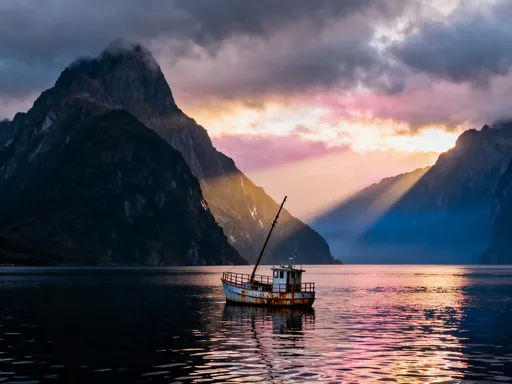
Milford Sound and Doubtful Sound are the most famous examples, but they represent only a fraction of Fiordland’s 14 fiords. Milford, often called the “eighth wonder of the world,” features Mitre Peak rising 1,692 meters directly from the water. Doubtful Sound, less visited but equally majestic, stretches over 40 kilometers inland and is accessible only by boat or plane, preserving its sense of isolation. Both are textbook examples of glacial carving, complete with hanging valleys—smaller glacial valleys left high above the main fiord—where waterfalls cascade hundreds of meters down cliff faces.
The scale of this transformation is difficult to grasp from the ground. But standing at the edge of the water, looking up at cliffs that seem to vanish into the clouds, one begins to appreciate the forces at work. These aren’t just mountains. They are monuments to ice and time, sculpted with a patience no human hand could ever match. The geology here isn’t static—it’s a living record, still evolving with every rainfall, every landslide, every shift in the Earth’s crust.
On the Water: Experiencing the Scale of the Fiords
There is no better way to understand the immensity of Fiordland than from the deck of a boat. On land, the forest canopy and rolling hills obscure the full picture. But on the water, the landscape opens up in a way that feels almost cinematic. The silence is profound—broken only by the cry of a takahe or the distant roar of a waterfall plunging from a hanging valley. The air is cool and moist, carrying the faint scent of salt and freshwater mixed together.
As the vessel moves deeper into the fiord, the walls rise higher, leaning inward as if closing off the sky. The water itself is dark—almost black—due to a layer of tannin-stained freshwater that floats atop the denser saltwater below. This unique stratification limits sunlight penetration, creating a mysterious, almost otherworldly appearance. Yet beneath this dark surface lies a thriving marine ecosystem, including rare black coral and deep-sea sponges that can live for centuries.
Local cruise operators, many of which are certified by the Department of Conservation for sustainable practices, offer journeys ranging from two-hour excursions to overnight voyages. These trips are carefully designed to minimize environmental impact while maximizing visitor experience. Passengers are briefed on wildlife etiquette, waste management, and the importance of staying within designated zones to protect sensitive habitats.
What stands out most during a boat cruise is the sense of scale. Photos rarely do justice to the verticality of the cliffs or the sheer volume of water falling from the heights. Stirling Falls in Milford Sound, for example, drops 155 meters in a single cascade—more than five times the height of Niagara Falls. When the boat passes beneath, the mist envelops everything, a natural baptism into the heart of the fiord. It’s in these moments that travelers truly feel small—not in a disempowering way, but in a humbling recognition of nature’s grandeur.
Above the Clouds: Flightseeing and Why It Changes Everything
While boat cruises reveal the fiords from within, scenic flights offer a completely different perspective—one that transforms understanding. From the air, the fragmented beauty coalesces into a vast, interconnected system. What appears as isolated valleys from the ground reveals itself as a network of glacial scars, radiating like fingers from the heart of the Southern Alps.
Small aircraft and helicopters, operated by licensed companies adhering to strict environmental regulations, take off from Te Anau or Queenstown. As the plane climbs, the patchwork of lakes, rivers, and dense rainforest unfolds below. The scale becomes almost incomprehensible. You can see the full length of Lake Te Anau, the serpentine curves of the Waiau River, and the distant peaks still holding remnants of ancient glaciers.
From this vantage point, the legacy of ice is unmistakable. The U-shaped valleys, cirques, and moraines—deposits of rock left behind by retreating glaciers—are clearly visible. Hidden lakes, inaccessible by foot, shimmer in remote basins. The isolation of the region becomes apparent; there are no roads, no buildings, no signs of human presence for miles. This is one of the most remote and pristine wilderness areas in the world.
Flightseeing isn’t just a luxury or a shortcut—it’s a form of education. It allows travelers to see the full context of what they’ve experienced on the ground. A waterfall seen from a boat becomes, from above, part of a larger drainage system feeding into the fiord. A hiking trail appears as a thin line etched into the mountainside, a fragile human mark on an otherwise untouched landscape. This aerial perspective fosters a deeper appreciation for the complexity and fragility of the ecosystem.
Tramping the Terrain: Trails That Tell the Story
For those who seek immersion, tramping—New Zealand’s term for hiking—offers the most intimate way to experience Fiordland. The region is home to some of the most celebrated multi-day tracks in the world, including the Milford Track and the Kepler Track. These are not casual walks. They are journeys that demand preparation, resilience, and respect for the environment.
The Milford Track, often called “the finest walk in the world,” spans 53.5 kilometers from Lake Te Anau to Milford Sound. It crosses mountain passes, follows crystal-clear rivers, and passes through ancient beech forests draped in moss and ferns. Each day unfolds a new chapter: alpine ridges with panoramic views, waterfalls tumbling into pristine pools, and the ever-present sound of rain on leaves. The track is managed by DOC, with a limited number of permits issued daily to prevent overcrowding and protect the trail.
The Kepler Track, a 60-kilometer loop, offers a different kind of challenge. It climbs to limestone bluffs with sweeping views of Lake Te Anau and descends into dense rainforest where native birds like the kiwi and kākāpi are sometimes spotted. Unlike the Milford, which is linear, the Kepler forms a complete circuit, allowing hikers to return to their starting point without retracing steps.
Both tracks require booking well in advance, proper gear, and a mindset attuned to changeable weather. Rain is not an exception here—it’s a constant. Fiordland receives some of the highest rainfall in the world, with certain areas recording over 6,000 millimeters annually. This moisture feeds the waterfalls, sustains the rainforest, and shapes the very character of the land. Hikers must carry waterproof clothing, navigation tools, and emergency supplies. But for those who come prepared, the rewards are immeasurable: solitude, connection, and a deep understanding of how the landscape evolved.
Beyond the Postcard: Unique Features Most Miss
Most visitors come for the views—the towering cliffs, the cascading waterfalls, the mirror-like waters. But Fiordland’s true uniqueness lies beneath the surface, in ecological features that few ever see. One of the most remarkable is the presence of deep-sea black coral in the fiords. Unlike tropical corals that live in warm, sunlit waters, these organisms thrive in cold, dark conditions at depths of 5 to 100 meters. Some colonies are over 400 years old, growing at a rate of less than one millimeter per year.
Another hidden wonder is the phenomenon of biofluorescence. In certain conditions, particularly after heavy rainfall, the freshwater layer on top of the fiord absorbs ultraviolet light and re-emits it as a soft blue glow. While not visible during the day, this effect can be seen at night with specialized equipment, adding a magical, almost alien quality to the water.
The rainfall itself is a defining feature. With annual precipitation exceeding 6,000 millimeters in some areas, Fiordland is one of the wettest places on Earth. This constant deluge feeds over 1,000 waterfalls—many of which appear only after rain—and sustains a lush temperate rainforest unlike any other. The forest floor is a tapestry of mosses, lichens, and ferns, creating a sponge-like layer that filters water and prevents erosion.
These elements combine to make Fiordland not just visually stunning, but ecologically unique. It is one of the few places where marine, freshwater, and forest ecosystems intersect in such a dramatic way. Conservation efforts focus on protecting this delicate balance, particularly from invasive species and the impacts of climate change. Understanding these hidden aspects enriches the visitor experience, transforming a scenic tour into a lesson in natural science.
Traveler’s Responsibility: Preserving the Wild
As Fiordland’s popularity grows, so does the responsibility of those who visit. The region’s ecosystems are fragile, shaped by isolation and slow recovery rates. A single careless act—straying from a trail, introducing a non-native seed, leaving waste—can have lasting consequences. Sustainable tourism is not optional here; it is essential.
The Department of Conservation leads efforts to manage visitor impact through a permit system, track maintenance, and public education. Travelers are encouraged to follow the Tiaki Promise, a commitment to care for New Zealand’s land, sea, and culture. This includes sticking to marked trails, disposing of waste properly, respecting wildlife, and using only approved transport and accommodation providers.
Choosing eco-certified operators, minimizing single-use plastics, and traveling in small groups all contribute to preservation. Equally important is cultivating the right mindset—one of humility and gratitude. This land was never meant for human convenience. It exists on its own terms, and our presence is a privilege, not a right.
By traveling mindfully, visitors become stewards rather than spectators. They help ensure that Fiordland remains wild, unspoiled, and awe-inspiring for generations to come. The beauty here is not just to be seen, but to be protected.
Te Anau’s landscape isn’t just a destination—it’s a reminder of Earth’s raw power and quiet majesty. By choosing to visit with care, travelers don’t just witness奇迹; they help ensure it lasts.